Aloe Vera emits oxygen at night, this helps you combat insomnia and improves your overall sleep quality. It is a low maintenance plant that doesn’t need much watering or direct sunlight . It also reproduces easily.
Lavender
Lavender is a plant well known for inducing sleep and to reduce anxiety, the aroma given off by the lavender slows down your heart rate and reduces anxiety levels. Keep the plant in sunlight and water often.
Jasmine
The smell of jasmine has been shown to improve the quality of sleep and increase alertness and productivity. studies have shown that I reduces anxiety levels, leading to a great quality of sleep. Jasmine needs a good amount of sunlight as well as a little shade, the soil also needs to be damp at all times.
English Ivy
It may be beneficial for those who sufferer from a respiratory problems such as asthma, studies show that English ivy can reduce air moulds to 94% in 12 hours. Keep in a well lit area and keep the soil damp at all times.
Snake plant
Snake plants emit oxygen during the night, whilst taking in the carbon dioxide from the air inside your home. It also filters out any nasty house hold toxins from the air. This plant doesn’t need much attention as it only needs to be watered every 2-3 weeks and can be placed in any form of light sunlight.
All photos are copyright free, all credit go to the owners of the images. all information sourced from various websites and again all credit geos to the owners of the information.
Already starting to plan this years garden so I thought I should do a post on Witch Gardens
Moonlight Garden
A garden that blooms in the moonlight, a great place to perform night time rituals, meditations, or to just take a midnight stroll. A garden that is full of magick even after the sun sets.
Plants to add in your moonlight garden:
Moonflower: (Ipomoea alba) A nocturnal relative of the morning glory. Has fragrant flowers that open at dusk and close by dawn.
Evening Primrose: (Oenothera biennis) Has beautiful, scented flowers that bloom only at dusk.
Night Flox: (Zaluzianskya capensis) A sweetly fragranced flower that only unfurls its pinwheeled shaped flowers after dusk.
Four O’Clock: (Mirabilis jalapa) Its scented flowers bloom at around 4:00pm (hence its name) and do not close up until morning.
Queen of the Night: (Epiphyllum oxypetalum) A species of cactus whose flowers only open at night. Attracts moths and bats!!!
Night Blooming Jessamine: (Cestrum nocturnum) Strong, sweet scented star shaped flowers that only bloom at night. Attracts moths and bats!!! All parts are toxic, do not ingest!
Angel’s Trumpet: (Brugmansia) Produces a strong scent on warm summer evenings. All parts are toxic, do not ingest!
Evening Stock: (Matthiola longipetala) Produces lots of small blossoms that produce a perfume described as a mix of vanilla, rose, spice, and cloves only after the sun sets.
Ever-Flowering Gladiolus: (Gladiolus tristis) Release a strong almond fragrance after dusk.
Lilac: (Syringa vulgaris) Although has a perfume during the day, it is said to be a lot stronger after dark.
Flowering Tobacco: (Nicotiana) Open in the late afternoon and have a fragrance that smells of jasmine. All parts are toxic if ingested!
Summer Snapdragon: (Angelonia angustifolia) Preferably in white, to reflect the moonlight. Has a scent apple-scented foliage.
Silvermound: (Artemisia schmidtiana) Has thick foliage that will shimmer under the moonlight.
Jack Frost: (Brunnera macrophylla) Hdeart shaped leaves of silver and green, perfect to add more highlights of silver to your moon lit garden.
Any plant that blooms after dark or has white, lavender, pale pink, pale yellow on it is a perfect addition to your moonlight garden.
Things to add:
Stepping stones that have the phases of the moon.
Fairy lights
A place to sit
Candles
A small fountain to sing along with the insects and birds of the night
String charms and bells on tree branches for a soft jingling every time a gentle breeze passes.
Herb Garden
For witches who need a more practical garden for uses of healing, tea crafting, drying, and growing plants used in their practices.
Plants to add to your herb garden:
Anise: Helps to ward of the evil eye, find happiness, and stimulates psychic abilities.
Basil: Use for anything pertaining with love, exorcism, wealth, sympathy, and protection. Dispels confusion, fears & weakness. Drives off hostile spirits.
Bergamont: Corresponds with money and prosperity. Provides with protection from evil and illness, improves memory, stops interference, and promotes restful sleep.
Borage: Corresponds with courage and psychic powers.
Cat Nip: Is sacred to the Goddess Bast. Brings forth beauty, happiness, good luck, and good spirits.
Chamomile: Corresponds with love, healing, and sleep. Is known to reduce stress.
Chervil: Brings a sense of the higher self, placing you in touch with your divine, immortal spirit.
Coriander: Corresponds with love, health, immortality, and protection.
Dill: Corresponds with money, protection, luck and lust.
Lemon Balm: Corresponds with love, success, healing, and psychic/spiritual development.
Marjoram: Used to cleanse, purify, and to dispel negative energy.
Mint: Promotes energy, communication and vitality.
Oregano: Corresponds with joy, strength, vitality, and added energy
Parsley: Calms and protects the home.
Rosemary: Protects, cleanses, purifies, and aids memory.
Sage: Used for self purification and dealing with grief and loss.
Thyme: Attracts loyalty, affection, and the good opinion of others.
Things to add:
A place to dry herbs
A place to compost any herb scraps
Rocks
A place to leave offerings before you harvest
Bee Garden
Make yourself a sanctuary to watch bees frolic and thrive
Plants to add to your bee garden:
Bee balm
Lavender
Crocus
Snow Drop
Wildflowers/Any native species
Catmint
Borage
Anise hyssop
Heliotrope
Sunflower
Oregano
Yarrow
Coneflower
Black eyed susan
Asters
Goldenrod
Foxglove
Marigold
Pansies
Sweet peas
Nasturtiums
Things to add:
Bee houses
Bee waterers/bee baths
Bee feeders
A place for offerings to the bees
Some other ideas for your garden:
Hummingbird garden
Medicinal garden
A garden whose plants and decorations represent/correspond with your practice.
Butterfly Garden
Faerie Garden
The options are endless! I hope this gives you some ideas for this years garden.
Happy planting!
==Moonlight Academy==
Look at my tiny plant child that I illegally downloaded
Faced with the expense of building raised beds, I
decided instead to go cheap and easy: a straw bale garden. So I called
up Joel Karsten, author of Straw Bale Gardens, and lead authority on all things straw.
Karsten argues that straw is an ideal “container” for growing
vegetables. “The hollow tubes are designed by Mother Nature to suck up
and hold moisture,” he told me. And as the insides of the bales
decompose, they provide a rich medium for vegetable growth.
You can put together a straw bale garden right on your lawn, your
driveway (oh yes, your neighbors will love you) or anywhere that gets at
least six to eight hours of sun. It’s especially good for growers who
live in northern climes with shorter growing seasons — the bales heat up
much quicker than soil, stimulating early-season root growth.
1. Source your straw You can toss the dice like I did and purchase straw bales from your
local garden center, but it’s best to source them direct from the farm.
If you want to garden organically, the person at the garden center won’t
likely know how the straw was grown. To help connect farmers with
growers, Karsten has set up a user-generated marketplace,
but it’s still too small to be useful to most gardeners. Remember,
straw is easiest to come by in the fall. If you arrange your straw bale
garden before the winter, you’ll be all set to plant when springtime
comes.
2. Position your bales Before you set up your bales, lay down landscape fabric to prevent
weeds from growing up through the bales. Arrange the bales side by side
in rows, with their cut sides up. The strings that bind the bales should
run across the sides, not across the planting surface. The strings will
help keep the shape of the bales as they start to soften and decompose.
3. Condition the bales Two weeks before you plant, you have to get the bales cooking. This
means wetting and fertilizing the bales for roughly 10 days to start
composting the inner straw. For the first six days, put down 3 cups of
organic fertilizer per bale every other day, and water the bales to push
the fertilizer down and thoroughly saturate the straw. On the off days,
simply water the bales. (Tip: try to ignore the neighbors staring
suspiciously from their windows.) Days 7 through 9, lay down 1.5 cups of
organic fertilizer each day and water. Day 10 put down 3 cups with
phosphorus and potassium (bone or fish meal mixed with 50% wood ash
works like a charm). If you stick your finger into your bales, they’ll be hot and moist.
You’ll start to see some “peppering” — black soil-like clumps that
signal the beginning of the composting that will continue through the
growing season. If mushrooms sprout up, rejoice — they won’t harm your
plants; it means the straw is decomposing as it should.
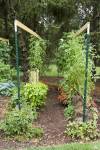
4. Build a trellis and greenhouse in one One of the coolest things about straw bale gardening is that it
combines the best of container gardening with vertical gardening.
Karsten recommends erecting seven-foot-tall posts at the end of each row
of bales, and running wire between them at intervals of 10 inches from
the tops of the bales. As your seeds sprout, you can use the bottom wire
to drape a plastic tarp to create an instant greenhouse for those
chilly early-season nights. And as the plants begin to grow, the wire
works like a vertical trellis, supporting your cucumbers, squash and
assorted viney vegetables.
5. Time to plant If you’re planting seedlings, use your trowel to separate the straw
in the shape of a hole and add some sterile planting mix to help cover
the exposed roots. If you’re planting seeds, then cover the bales with a
one to two-inch layer of planting mix and sew into this seedbed. As the
seeds germinate, they’ll grow roots down into the bale itself. While
you’re at it, plant some annual flowers into the sides of the bales, or
some herbs — it’s otherwise underutilized growing space, and will make
the garden a whole lot lovelier.
6. Look, ma — no weeding If you lay a soaker hose over your bales, you’ve pretty much
eliminated all your work until harvest. That’s because your “soil”
doesn’t contain weed seeds. There’s one caveat, though — if you didn’t
get your straw from a farmer (guilty as charged), there’s a chance your
straw (or, worse, hay that was sold as straw) contains its own seed. If
your bales start to sprout what looks like grass, you can beat back the
Chia pet effect by washing the sprouts with diluted vinegar. If you
don’t mind the look though, the grass shouldn’t harm your plants, and
will likely die off from the heat produced by the bale’s decomposition.
7. The harvest after the harvest When the harvest season ends, the bales will be soft, saggy and gray —
but that’s exactly what you want. Because when you pile the straw
together and leave it to compost over winter, you’ll have a mound of
beautiful compost to fill all your pots and planters in the spring.
Have never done this, but I am super interested! Pretty amazing.
I’ve done this in my class because our ‘garden area’ was all gravel. Works pretty well!
We did the Land ride at Epcot and when I heard we were going to ride through greenhouses j was excited, but when I SAW their nutrient film system and vertical growing and their circular systems with the fish farms it really got me fired up for sustainable living again.
I put a note on the bonsai that said “don’t forget to water me when I’m dry! :)” but you just know I’ll come back in a week and it will be like “Please. I can’t cry because I have no moisture. Please soak me, I can’t take it anymore.” and I’ll have to revive it.
It was a father’s day present, so it’s actually my dad’s, but he’s been sick all month and when my mom tried watering it she did it from above and started washing the soil away- so I’ve been taking care of the little guy. Despite my black thumb with most other plants, I have a strangely green one with specifically trees, so I’m hoping that until my dad gets better (which won’t be for a long while, based on his limp) I can keep this little juniper going strong.
boiled off the wax from some bayberries! candles of bayberry wax are supposed to be useful for good luck and money spells.
I learned about this process of wax gleaning from a candle-making revolutionary war re-enactor, who told me that these candles were less common than lard-based ones, but higher quality. Secondary in quality only to whale blubber lanterns.
This is so cool!! @witchposting how did you do this??
Omg I’d be so fascinated to learn how this is done
It’s pretty easy! I’m lucky enough to live near a beach where these plants proliferate. So even though the ratio of wax yield to berries is pretty low, (like 1/16 of the weight of berries you collect will be wax,) I was able to harvest a good amount without disrupting the plant’s role as a winter food source for birds.
To get the wax, you just bring the berries to a boil in water. The waxy coating will melt off of the berries and float to the surface of the water, and when the water cools, the wax hardens and remains on top. There will be some berries and twigs and dirt embedded in the wax at that point, so you have to re-melt the wax and pour it through some sort of fine metal mesh to get all of those out.
It’s also important that you use pots and containers that you don’t mind having wax stuck to–maybe forever. And keep in mind that you don’t want wax going down your household drains.
During the purifying process, what I did was just cut some aluminum beer cans in half and poured the hot wax through a sieve into those. That way, if the wax was stubborn after cooling, it could just be easily cut out of the can with scissors.
ALSO you will notice, if you try this, that the water you boiled the berries in turns a deep rosy red and has a beautiful aroma. You can drink it! Or reduce it and use it to make a syrup or something. I’ve read that it has been used in folk medicine as a tonic and to treat diarrhea. Also the root bark apparently has medicinal uses. Plants!!!!
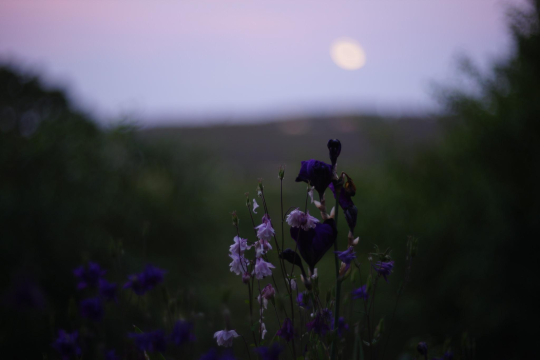
A moon garden is a garden specifically designed to be enjoyed by the light of the moon at night. It is typically planted with flowers and plants that are at their best after the sun has set. Some have blooms that only open at night, some release their fragrance into the cool night air and others simply have lovely silver foliage and white flowers that glow softly in the moonlight. Plants that resonate with the energy of the moon are also welcome in a moon garden, although they usually meet the other criteria as well.
A moon garden is a wonderful idea for night owls, for people who work long hours during the day and only get to enjoy their gardens at night, and, of course, for moon-worshipers!
Design Elements
To fully enjoy your moon garden, you will want a comfortable bench or perhaps a wooden swing to rest on in the cool of the evening.
The sound of a waterfall trickling through your plantings will provide a soothing backdrop to your evening meditation.
Consider adding a few (but not too many) glow-in-the dark garden decor pieces to help you navigate your way through the garden in the darkness and also to add a bit of magical flare. Consider creating stepping stones with glow in the dark pebbles or solar mason jars along your path to light your way.
Suggested Plants
Please note that many of these plants are poisonous and some are invasive. It is up to you to decide whether and where to plant them and to manage them responsibly. Please read the individual plant’s page carefully and do further research from other sources before purchasing and planting any of these.
Flowers that Open at Night:
evening primrose, night blooming cereus, night phlox "Midnight Candy", moonflower, night blooming daylily "Moon Frolic" or “Toltec Sundail”, night blooming water lily, night gladiolus, Casablanca lily, Nottingham catchfly, Four O’Clock, Dragon Fruit, Dutchman’s pipe cactus, night-blooming jasmine, angel’s trumpet, Evening Stock, Nicotiana/flowering tobacco
Flowers that Smell Their Best at Night:
Night Phlox, Night Blooming Jasmine, Evening Stock, Four O’Clock, August Lily, Moonflower, Tuberose, Garden Heliotrope, Mock Orange, Honeysuckle
Plants that Look Great in the Moonlight:
yucca, lily of the valley, magnolia, dogwood, lamb’s ear, sage
Ginger takes 10 months to mature and it doesn’t tolerate frost. If you live in a place where it gets chilly in the winter, you’d be better off growing ginger in a pot indoors and bringing it outside in the summertime.
Ginger is one of those miraculous plants that grows well in partial to full shade, which makes it ideal for growing in your home, where most people don’t have full sun pouring on their windows all day long.
Little bits of the ginger root can be removed while it continues to grow. A little bit of ginger goes a long way, so these pieces can be used for cooking, brewing tea or for herbal remedies.








 The Carving Witch