Torches leant in to hear his pleas.
Kerberos sat at attention, but his ears were bent towards the strange man with the lyre,
Orpheus whose voice serenaded rocks and streams,
Which glowed like a stream of sunlight from his lungs.
Haides listened intently to the boy’s gasps and prayers,
He learnt how he loved as deeply as the Underworld itself,
And would carve hearts into his own body to get joyous Eurydice back into his arms.
He, the King, wept diamonds as his thoughts drifted to his dearly belovéd Persephone.
Pomegranate seeds, six of the garnet beads, kept him from such a miserable fate as the son of a muse that stood before him.
Persephone held the strong youth in her eyes,
And yes, she saw what she heard in his forlorn song, so melancholic and minor.
His heart was falling, and it would shatter under anymore strain.
She agreed silently with her husband in one quick moment,
Just as Kerberos howled from the gate.
Orpheus had mastered sharing his grievance with the King of the dead and the Iron Queen.
What a victory.
What a shame it ended in further heartbreak.
summary/keywords: analysis of the verb harpazo (snatch away)
●
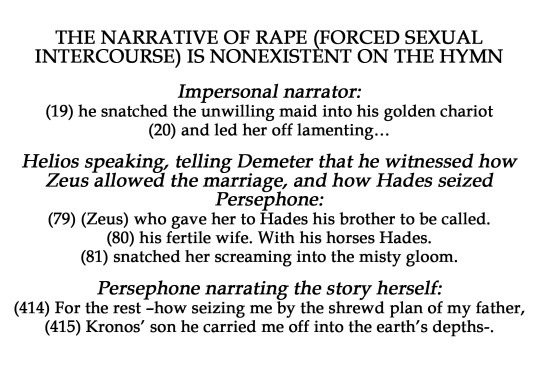
Hymn’s nonexistent rape narrative
●
the sorrow of Demeter and Persephone and its cause
●
Persephone’s wisdom
●
The attribution of honors (timai) ●
Hades and the pomegranate giving
● Pomegranate symbolism
●
Contradiction between narrator and Persephone’s voice
●
Hades and xenia (hospitality).
note: this analysis focuses mostly on the text of the Homeric Hymn to Demeter. We could expand the theme Hades and Persephone’s happy marriage based on cultus from multiple Ancient Greek cities which celebrated their marriage. And also, at Lokroi Epizephyrioi -south Italy- Persephone was the protectress of marriage. But these topics will be treated in a future post.
MISCONCEPTION 2: Hades raped, imprisoned and tricked Persephone.
The
HUGE problem with Hades and Persephone story, comes from the wrong translation or misunderstanding of the
verb ἁρπάζω / ἁρπάξας (line 19).Harpázō means snatch away, carry off. What Hades does is grab Persephone, get her on his chariot, and then both descend to the Underworld.
LATIN: The
verb ἁρπάζω / harpázō, in latin was rapiō which also means “carrying off”.
ENGLISH: The
English noun RAPE originated from
the latin (rapere), and it has the following meanings:
The act of seizing and carrying off by force / The abduction of a woman, especially for sexual purposes
►
TODAY, this is an
archaic meaning, so many people are not even aware of it.
The act of
forcing sexual intercourse upon another person without their consent or against their will.
When
anyone says “the story was called the Rape of Persephone” it actually means
“THE SEIZING of Persephone”. That is what the original Greek story tells, and
that was the story Ancient Greek and Romans repeated during centuries.
There is absolute NO narrative of rape in the Homeric Hymn to Demeter. What we are told repeatedly is that Persephone was seized. She was
taken against her will, yes. She screamed, yes. The action is described as
violent, yes. But there is NO rape narrative.
Persephone wears her dirt like makeup
Dabs raspberry juice on her lips as gloss
And puts flowers in her hair in the shape of a crown.
She can be an iron queen, destructive and fair when the time calls for it.
But she is also soft and sweet,
The same girl that rolled around above violets and lilac buds.
Her scepter is cracked and broken like the shared time between her husband and her mother,
And it is held together by both bone fragments and vines.
Persephone is equal parts darkness and sunlight,
A beautiful mix of divine balance.
People talk to her about getting guidance,
But what does she need them for?
She is the sublime mixture that we struggle to attain.
Artemis clamps her thighs around the magnolia branch and flicks another pebble at the window. It rattles against the screen. She whistles bob, bob, bobwhite and tosses another stone. The window scrapes against the frame as it’s opened. Persephone leans out, sunlight calling umber highlights out of her curls.
“Why? Ah have a perfectly good door. Plenty a people use it. Ah know it works jus fine. An yet, here Missy sits, chunkin rocks at mah window like she’s never heard a doorbells. Why??”
Artemis beams up at her cousin from among the white flowers and glossy leaves. “I like the tree.”
Persephone huffs, but the corners of her mouth curl upward. “Bless yer heart. Flowers today, or the river? Ah need to know which shoes to wear.”
“Flowers,” comes the firm reply. “Bergamot and sweet alyssum and all the pretty things you can find out by Mammaw’s. Comin’ down?”
“Ah’ll meet you,” Persephone leans back out, both hands flying through her hair to tame her curls into braids, “at the door.”
DEMETER: I sent you to Hades so you could be stronger and now you are, so come back.
PERSEPHONE: No.
DEMETER: What! You dare defy me? Wilful child.
PERSEPHONE: I am no child. I am a ruler and Hades himself quivers before me. I bring the Erinyes to their knees. I am become an arrow, poised in flight. Save your threats, Mother, I quite like winter, it is as cold as me –
Persephone is the girl who drinks pomegranate juice
And sits in the corner
She takes photos of nature
And grows lavender in her window-box
She is the girl who always buys the freshest peaches
The girl who takes off her shoes to run in the park
But she is also the girl
With a set of brass knuckles
Hidden in the pocket of her skirt.
I think I like the last set better, but these are nice too! Even though the dress is a bit of an odd fit for this location I really like how it looks against the warm tones of the backdrop. I’m so glad they let us take pictures there.
I made the dress and headpiece in a week. It’s inspired by the dress in this Heinrich Mucke painting and how saints were depicted in Renaissance times. I made it from seven yards of foil printed sari fabric and five yards of polyester suiting. The neckline is embellished with gold sequins and seed beads to match the gold printing on the fabric.
The headpiece is made from skewers and dried roses~
If you want to read about the process, I have a write up on my blog! And a bunch more photos are posted here!
This is supposed to happen the first time Persephone is back to the Underworld….so I went and made a sequel for a comic that hasn’t even happened yet. Wibbly wobbly timey wimey….
twhere do people read romance into this, where??ßß1ßewkofp *flops over*
Thanks for continue to focus on the kidnapping part which is not the point of this myth.
Life and Death, the balance between them and the changes they cause, and the origin and meaning of the seasons cycle, on the other hand, are the real points.
Thanks for also persisting in the idea of Persephone as a passive figure. Kidnapped, raped, silenced, with no saying or power over anything (except for maybe starved herself because there are so many different versions of this myth that it’s difficult to keep track of them, did you know that apparently there is a version where she and Hades plot together?)
Thanks for also forgetting that she’s a goddess on her own and becomes Queen and Hades’ equal and actually they’re most stable marriages in the myths.
Thank you, you’ve enriched this post by telling me things I already know but I don’t care about. (◡‿◡✿)
Reblogging for the bitchin’ commentary and also to add that if anyone wants to read the most current (and IMO accurate) studies on Greek mythology and women’s lives, Women in Greek Myth by Dr. Mary Lefkowitz is invaluable (and incredibly inexpensive for an academic book).
The confusion comes from “Zeus” which is almost a title for a supreme god (think of the way “Caesar” was used). So you have Heavenly Zeus and Infernal Zeus, and they are not the same god but rather the supreme ruler of the sky and underworld, respectively. Likewise Persephone became known as “Infernal Hera” and this naming scheme persisted well into the Roman Empire, where Pluto and Proserpina are referred to as “Infernal Juno” and “Jupiter of Dis” in Book 6 of the Aeneid as well as on many grave monuments and in spells.
Moreover, gods don’t need to eat. Persephone refusing to eat was her refusing to become a part of the Underworld, not her attempting to starve herself. The gods are defined as being deathless, and in Ancient Greek “deathless” is synonymous with “god”. (Cf. Theogony, Works and Days, any of the Homeric Hymns, etc.) The Homeric Hymn to Demeter is really clear about this. (HH 2 370-4, 393-403.)
The marriage of Persephone and Hades is actually the most loving and consensual union among the Olympian deities. Hades first offers a dowry designed specifically to please Persephone (HH 2 10-14.), then carries her off and keeps her as a guest of honour in his house. (HH 2 341-345) Persephone is referred to as αἰδοίῃ παρακοίτι – his reverent wife. “Reverent” here refers to a respect for one’s duty, and the similarity between the pronunciation of αἰδοῖος an “Hades” is deliberate and intended to show how well-matched they are. Persephone misses her mother, yes, but is not overly upset about her marriage to Hades. Even Anchises expresses more regret over his union with Aphrodite. (HH 5 185-190.) Finally, as a proper parent, Demeter is rewarded for giving up her daughter, and offers a gift to the other gods in turn. (HH 2 441-495.)
It is worth noting that Demeter is given a position of remarkable power in this myth and is in many ways treated as or better than a father would be. The focus of the hymn remains the relationship between mother and daughter, and emphasises that it is a bond that can endure even after a woman leaves to marry. More importantly, the Homeric Hymn to Demeter is an etiological myth for the Thesmophoria and the Eleusinian Mysteries, a woman-only festival and the most enduring mystery cult of the ancient world. HH 2 serves to anchor women firmly in religious and family life and sets some fairly idealised standards for husbands. Many issues arise when attempting to interpret this myth into a modern context, which is why it is so important to understand that the myth was created over three thousand years ago and is largely a historical document reflecting the mores of the time.
This is the last time I’m reblogging this strip. I edited the original post because I’m really tired of this discussion, but latining’s comment is just perfect and flawless and really educating and everyone interested in this myth should read it.
THIS IS FUCKING BEAUTIFUL AND IM SO GLAD THAT MY BOYFRIEND REBLOGGED IT FOR ME TO SEE AND TO READ THE COMMENTS OMFG
Also like to point out that Hades and Persephone were one of, if not the, most faithful divine couples in Greek mythology.
Compare that to Zeus, who slept with anything that moved.
This comic is beautiful and adorable, and the commentary is (if you’ll pardon the pun) divine. A++, FAVORITE MYTHOLOGICAL COUPLE, WOULD FALL IN LOVE WITH THEM AGAIN.

 The Carving Witch