Imagine children of Hephaestus being born with parts of their bodies being made of metal. It varies how weird or horrific the placement of these parts are. Many children with born with metal limbs build better, more stylish ones for themselves
Imagine children of Aphrodite that are born with the power to change their appearance, but they can’t control it. They change when their emotions are high or just randomly throughout the day. Sometimes they’ll have two different faces and not be able to do anything about it
Imagine children of Apollo being literally made of light. There’s always a soft glow coming from their eyes, nose, and mouth. They get hard to look at when they’re mad but they also make good flashlights
Imagine children of Ares who just casually spill blood all the time. Out of their mouths, ears, eyes, and noses. Just randomly, no warning. Sometime random small wounds will open up on their arms, legs, and faces. New campers are very scared of them
Imagine children of Athena who physically shut down from information over load; they can’t move, can’t speak, don’t even breathe so their brains can review all the things they know. When they’re in this state you can literally see words and pictures flash across their eyes. Don’t disturb them in this state, it won’t be good for either of you
Imagine children of Demeter who have flowers and other flora growing out of their bodies. Little roses (thorns and all) growing out of their heads, lilies growing from their shoulders. Sometimes their hair will start turning green
Imagine children of Dionysus with grape juice for blood. When they get older, it ferments and turns to wine. They can will vines to grow out of their bodies, though the grapes on those vines will make anyone else sick
Imagine children of Hermes who talk so fast, their voice can’t catch up. They’ll be talking and suddenly, their voice gives out. But they still keep talking. When they stop, their voice keeps going once it’s able to catch up
Imagine children of Hades with see through skin. All the bones, veins, organs, and everything is visible. Sometimes, depending on a lot of things, their skin is more translucent than normal
Imagine children of Poseidon being born with aquatic features; scales, gills, webbed hands/feet, slimy skin, etc. Some are able to go fine without water, while some need it or they get sick. They won’t die but they will be quite miserable
Imagine children of Zeus who are made of lightning. You can see it under their skin, jumping from one body part to the next. Their eyes have lightning and them always look like colored storm clouds. Touching them is always an endeavor in trying not to get shocked too badly
Imagine really cool side effects to being half all powerful God
So, I’ve been told that using a hijab style veil is okay, as long as you’re not doing anything that’s going to reflect badly on Islam. If you’re wanting to avoid glares, then you’re probably going to want to avoid the ‘noticeable’ styles of veiling.
If you’re interested in Hellenic styles of veiling, you’ve got a bunch of options available to you as well. You’ve got the himation, which can be done with a large scarf
There are also a wide variety of styles that utilize a headband or smaller cloth.
While you may look at these pictures and be thinking, “That’s way to intricate! I just want something to do for every day veiling!” when you look at them more closely, they aren’t all complicated. Take the bottom most right hand illustration in the last image for example. It’s a “coiffure of Venus de Milo”, and it looks a LOT like a headband and bun combo. The look in the middle image (the statue) could be created with a few layered headbands. The left most image in the top row of the first illustration looks like it could be done with a snood or a scarf.
Devotional accessories. I’ve got jewelry I wear for different theoi, as well as devotional perfumes and eyeshadows. If I’m feeling particularly attached to Aphrodite one day, I’ll put on my pink glitter eye shadow to start the day. Feeling more Haides? The gold eyeshadow it is.
Daily Prayer. This doesn’t have to be elaborate. It can be super simple and situationally appropriate. I thank Hermes almost every day, whenever I finish helping a particularly difficult customer. And it’s just a quick, “Thank you Blessed Hermes, who’s quick wit and sharp tongue guide me.”
Ritual cleansing (this can be as simple as washing your hands while focusing on cleansing and your deities)
Read a quote or line of poetry that reminds you of your deities
Organize a playlist for them, and play that while you’re doing other things (cleaning, driving,homework, ect..)
Dedicate things you’re already doing. Cleaning the kitchen? Dedicate it to Hestia. Making your bed? Let Hypnos know you’re thinking of him. Doing your French homework? Dedicate that to Hermes.
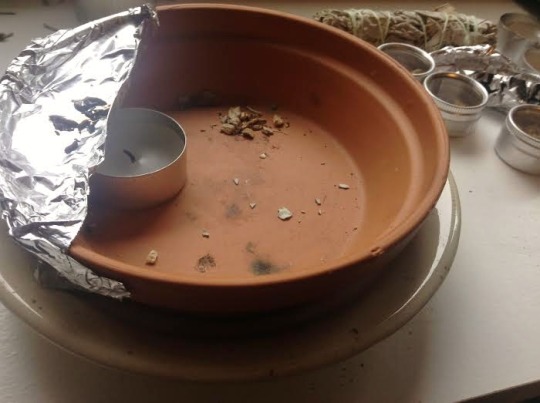
For that matter, you don’t need a charcoal burner, tongs, sand, or the willingness to handle something that sparks and burns dangerously hot. You don’t need any of the things that every website insists you need to burn resin, herbs, or loose/granular incense mixes.
All you need is a tea light, aluminium foil, and a shallow (fire safe) dish.
Drape the aluminium foil over part of the dish and pinch around the rim so it stays securely in place. Turn up the inner edge or dent it a bit if you’re working with resins that liquefy when they heat up. Put the resin/herbs on the foil. Light a tealight and set it so the flame touches the foil (it doesn’t have to be completely underneath). Done!
My setup looks like this:
If you want, keep delicate herbs further away from the flame so they don’t burn until they’re acrid. Try to avoid touching the foil because it conducts a lot of heat, though I’ve never gotten an actual burn from it. Most herbs you can just brush off when you’re done and reuse the foil. If you’re using resin, some residue will probably remain after several uses and you might want to replace it if you don’t want a slight undercurrent of frankincense or whatever next time (or keep that piece of foil reserved for that specific resin).
This cost me nothing. It’s sturdy and I can’t knock it over accidentally. It’s not as smoky as charcoal methods because it doesn’t burn as hot, and if you arrange things right you can get scent with no smoke which is great if you’re concerned about smoke inhalation. I can just blow it out when I’m done. It doesn’t get the nasty smell that people complain about with self-igniting charcoal. Resins last a long time because they are heated gently and just ooze, solidify, and ooze again when reheated. It’s not as pretty as fancy burners but it’s safe, fast, and functional.
I never see methods recommended that don’t use charcoal, and charcoal burning just isn’t accessible for me. Hope this helps others having similar issues.
This is VERY useful to me, as I live in a tiny studio. I think I could burn small amounts of resin using this method, as long as I could open the windows.
Reblog to save a Hellenic polytheist’s apartment.
Dionysus: We’re all bad people. That’s the only thing we have in common.
Hermes: Apart from Hestia.
Ouranic deities tended to receive wine libations that were mixed with water. Khthonic deities received either wineless libations (water, milk, and honey, usually), or wine libations of unmixed wine. ‘Ouranic’ is a term that applies to Theoi and practices who reside or that are associated with Mount Olympos, home of many of the Theoi. As such, Ouranic deities are also referred to as ‘Olympians’. ‘Kthonic’ refers to deities or spirits of the Underworld or the earth, and the rituals associated with Them. Then there are some we know from the ancient writings.
So, some examples: Apollon (ouranic) recieves mixed wine libations. Gaia (kthonic, earth) recieves water libations (usually khernips), or milk, or honey. Water for the nymphs (kthonic, earth), unmixed wine to Persephone (kthonic), milk (usually kykeon) to Demeter (kthonic, earth), etc.
I may not be the best person to answer this because I’m a pretty strict hard polytheist, so I’m biased. I know that Hellenistic polytheism is more soft by nature because it focuses on the era in time after the death of Alexander the Great when there was a lot of
syncretism between Greece and Egypt. Also, I’m sure there are soft polytheists out there who are practicing Hellenic polytheists, so I’m not going to say you can’t be a soft polytheist while practicing HP.
There is one problem with this question as it is that actually may help the person who is asking: the hard/soft polytheist distinction. In antiquity, it’s not clear that hard polytheism as we know it existed.
Gods were different from place to place, from time to time. The god that was known as Zeus in one place may have been much different than the god known as Zeus in another. Gods from different pantheons were associated with the gods in their own, to the point where they become one larger syncretic entity in and of themself that has aspects of the different gods.
Now the confusion comes not in pure syncretism between pantheons as seen in Hellenistic times, but the local differences between gods. Some gods that may have been seen as the same by the people in the places, or had identical qualities, may have been called by different names. Some gods may have had similar personalities and similar aspects but different names. To draw lines in the sand between gods that overlapped in such a way requires removing the overlapping characteristics from one god and only apply them to the other or vice versa.
A great example that I’ve personally been researching lately would be that of Artemis and Hekate, particularly as they were seen in Asia Minor. Both are child-bearers, both maidens who see over the transition to marriage, light-bringers, torch-bearers, who lead down paths. There are two goddesses who have such similar traits that sometimes you’re not sure whether they’re just similar or just the same. And that happens all the time in ancient texts! Hymns, prayers, you’ll find a bunch that refer to Artemis as Hekate and Hekate as Artemis, even using specific traits of one to refer to the other. It’s a weird grey area.
Let’s go even deeper, okay? The specific area of my research has to do with Anatolia. In Anatolia, the triad of Kybele-Hermes-Hekate was an equivalent to the triad of Leto-Apollon-Artemis, with Kybele and Leto both being versions of the local mother goddess of the area (who was merely referred to as “Mother”). In that time and place, Kybele and Leto were names for the same god, the Mother. Hermes and Apollon were names for the same god, the son of the Mother, and Hekate and Artemis were names for the same god, the daughter of the Mother.
With that in mind, how does that affect the hard/soft distinction? The mother and the daughter weren’t the same, no matter what you called them. The daughter, whether you called her Artemis or Hekate, wasn’t the same as the goddess who was called Athene in Greek. So it’s not the same as the Wiccan duotheism type of soft polytheism where all gods and goddesses are all one god and goddess.
And yet it isn’t completely different. Where does that leave us? At this point, I’m left questioning the whole hard/soft polytheism distinction as it relates to Hellenic Polytheism. It’s not necessarily the most historically accurate form of worship, despite sometimes being sold as more historically accurate way. It’s impossible to say how the ancients thought, since we aren’t them. But I think it’s important to keep examining and re-examining the concepts we sometimes take for granted and our relationships with them.
(Also, if anyone’s interested in that Anatolia information, I can direct you to some books and papers on the subject! It’s really quite interesting.)
My resources and links, without the clutter of my FAQ, my altar pics, or my theoi specific sections that are on my ‘building your worship’ page (linked below)
a friendly, gentle reminder, if you need it, or if you’re feeling unsure:
the gods want to be worshipped. they grant us many things and return, we open ourselves to them and give in return. thegods want to be worshipped. even the smallest offering, the smallest prayer, the smallest act of devotion, when given with reverence and love is just as good and deserving as a large and elaborate ritual. the gods want to be worshipped. they want to hear your voice singing them a hymn, reciting them a poem, saying a few words of gratitude and praise.
if you’re feeling unsure, unworthy, or undeserving, it’s alright. we all feel that way. but give anyway. even if it’s small, even if you don’t think it’s good enough, give. give with all your heart, with all of the love that brings you to them in the first place.
all you need to do is the best you can. they will understand. they know what’s in your heart.
that’s enough. what you can do is enough.
you are not unworthy.
In the new age, Artemis is a girl
who doesn’t believe in love.
Aims her arrows at the stars,
sees Orion in the night sky.
Drops her bow, doesn’t
pick it up again.
(The twenty-first century has no room
for warriors and huntresses and
goddesses who bleed silver,
if they bleed at all.)
In the new age, Apollo is a boy
who loves far too deeply.
Falls head over heels for
a girl wreathed in laurel.
Out there, in a big city
somewhere, Eros laughs.
(The twenty-first century has no space
for poets and musicians and
golden-hearted gods
left shining alone.)
In the new age, the twins
can’t find each other.
The forests are cut down and
the sun hides behind smoke.


 The Carving Witch