INGREDIENTS
Lavender Cake:
¾ cup milk
3 tablespoons finely chopped fresh lavender
6 tablespoons butter, softened
1 cup white sugar
2 eggs
2 cups all-purpose flour
1 ½ teaspoons baking powder
¼ teaspoon salt
Lavender Glaze:
½ cup milk
1 tablespoon dried lavender buds
1 cup confectioner’s sugar
PREPARATION
Cake: Preheat the oven to 325 degrees F (165 degrees C). Grease and flour a 9×5 inch loaf pan. Combine the milk and lavender in a small saucepan over medium heat. Heat to a simmer, then remove from heat, and allow to cool slightly. In a medium bowl, cream together the butter and sugar until smooth. Beat in the egg until the mixture is light and fluffy. Combine the flour, baking powder, and salt; stir into the creamed mixture alternately with the milk and lavender until just blended. Pour into the prepared pan. Bake for 50 minutes in the preheated oven, or until a wooden pick inserted into the crown of the loaf comes out clean. Cool in the pan on a wire rack.
Lavender Glaze: Place the milk in a saucepan over medium heat. When it starts to boil, take the pan off the heat and add the dried lavender buds. Let the mixture steep for 5-8 minutes, then strain the milk Whisk it into the sugar, a tablespoon at a time, until you get a smooth and opaque glaze. Pour or spoon over the cooled loaf.
More properly, Hekate is Ariste Chthonia, the Best of the Earthly Gods, a title shared by Demeter and Artemis. The root of ariste means excellence or prowess, and is the root of the English word Aristocracy.
There is decidedly little in the resources pertaining to this title, outside of a footnote in Cook’s opus on Zeus. But the Greeks talked a lot about the quality of excellence itself, and how it applied to both the Gods and humanity.
One Hesiodic text mentioned by Pindar says that “The Gods have placed sweat before excellence.” Meaning one must work to attain our best. (p. 120) In spite of the fact that the Ancient Greeks limited excellence to something for the aristocratic men to pursue (113), we are not beholden to such prejudices, and can believe that everyone is capable of working towards their personal best. This is not an interpretation that Plato, nor any other ancient Greek, would be comfortable espousing, but it is one that I believe strives closer to the Good than their own.
We need not be enslaved to every aspect of the old world in our reconstructions. Indeed, one can argue that being thus enamored of the past means embracing a lot of activities and beliefs that are frankly anathema to us today.
Aristotle in his Ethics expounds extensively on what it is to be excellent, and how to strive towards it. He believes that each skill and person has its unique excellence, which should be attained if at all possible. Further that excellence is a necessity for the good of the human soul. Thankfully, he admits that different situations call for different measures of excellence. One cannot assume that what is excellent for a child beginning school is the same as what it would be for an adult in their chosen field. Further, one’s actions, in order to be aimed at excellence, must follow the right reasons.
Some personal thoughts on excellence: As mortals we often struggle to attain excellence. Recent events have shown just how far we can fall away from our best. To be our best requires work. Hard, sweaty, sometimes boring work. It can hurt to get there. All of that is perfectly okay. We will fall short. We will fuck it all up. The important part is what we do with those shortcomings. Do we retreat and abuse ourselves for it? Or do we use those moments as stepping stones across the difficulties? Mistakes are part of life, and a necessary part of being our best. We needs must pick ourselves up, do what we can to make amends if necessary, and always strive to be better. Not better than others, better than our prior selves. This is a huge part of the Work, and it will span multiple lifetimes, but we can do it.
Sources:
Lsj.translatum.gr
Anton, John Peter, George L. Kustas, Anthony Preus, eds. Essays in Ancient Greek Philosophy IV: Aristotle’s Ethics, SUNY, 1971.
Cook, A.B. Zeus: A Study in Ancient Religion, Vol. 2, Part 2, Cambridge, 2010.
Stamatopoulou, Zoe. Hesiod and Classical Greek Poetry: Reception and Transformation in the Fifth Century BCE, Cambridge, 2017.
I’m afraid I’m beginning to fall into the same Small Pond Big Fish syndrome that got me too cocky and fucked me over the first time I applied for grad school
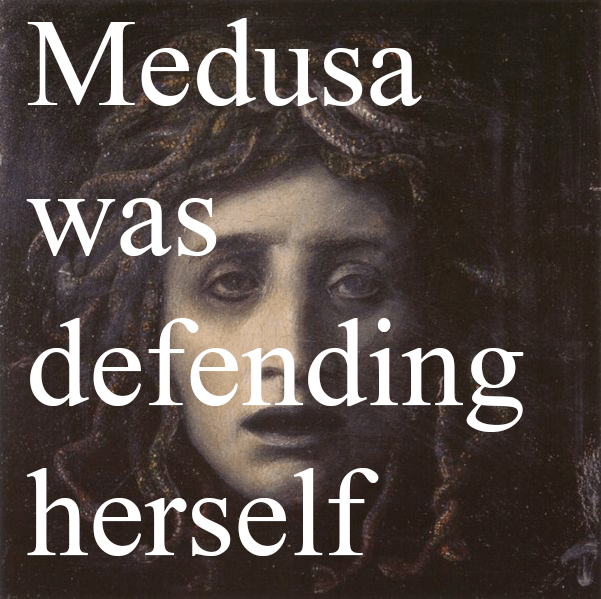
Athena blessed her with the ability to protect herself and men beheaded her for it.
That’s actually a really intetesting intpretation of it I hadn’t thought of. Most people seem to think Athena turned Medusa into a gorgon as punishment for defiling her temple, but thinking that she did so to protect her from being abused again is interesting and I like it!
Athena’s hands were tied. Yes, she was a powerful Goddess, but she was very much a woman in a “boys club”, and the true offending party (don’t think for a moment that Athena blamed Medusa for being raped in the temple, Athena knows better) held all the cards. There was nothing that Athena could do to punish the true criminal, and she was expected to punish Medusa by everyone else. What’s a Goddess to do when she cannot punish those who need to be punished and is expected to punish not only the truly innocent party, but her most beloved follower? Use that incredible brain power she had to protect Medusa at all costs, and of course the men would see it as punishment, to be have her beauty stripped from her and sent to live in the shadows. Medusa should have been KILLED for supposedly defiling the temple, whether she truly did or not, but she was given the gift of life, and the ability to protect herself and her daughters (who she bore thanks to Poseidon). This is why Medusa’s image was used to signify woman’s shelters and safe houses.
Medusa means “guardian; protectress”, and she was.










 The Carving Witch