


“How to Build a Straw Bale Garden“ by Nicole Jolly
(via Modern Farmer)
Faced with the expense of building raised beds, I
decided instead to go cheap and easy: a straw bale garden. So I called
up Joel Karsten, author of Straw Bale Gardens, and lead authority on all things straw.
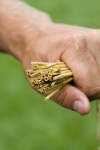
Karsten argues that straw is an ideal “container” for growing
vegetables. “The hollow tubes are designed by Mother Nature to suck up
and hold moisture,” he told me. And as the insides of the bales
decompose, they provide a rich medium for vegetable growth.
You can put together a straw bale garden right on your lawn, your
driveway (oh yes, your neighbors will love you) or anywhere that gets at
least six to eight hours of sun. It’s especially good for growers who
live in northern climes with shorter growing seasons — the bales heat up
much quicker than soil, stimulating early-season root growth.1. Source your straw
You can toss the dice like I did and purchase straw bales from your
local garden center, but it’s best to source them direct from the farm.
If you want to garden organically, the person at the garden center won’t
likely know how the straw was grown. To help connect farmers with
growers, Karsten has set up a user-generated marketplace,
but it’s still too small to be useful to most gardeners. Remember,
straw is easiest to come by in the fall. If you arrange your straw bale
garden before the winter, you’ll be all set to plant when springtime
comes.2. Position your bales
Before you set up your bales, lay down landscape fabric to prevent
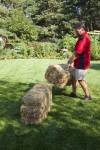
weeds from growing up through the bales. Arrange the bales side by side
in rows, with their cut sides up. The strings that bind the bales should
run across the sides, not across the planting surface. The strings will
help keep the shape of the bales as they start to soften and decompose.3. Condition the bales
Two weeks before you plant, you have to get the bales cooking. This
means wetting and fertilizing the bales for roughly 10 days to start
composting the inner straw. For the first six days, put down 3 cups of
organic fertilizer per bale every other day, and water the bales to push
the fertilizer down and thoroughly saturate the straw. On the off days,
simply water the bales. (Tip: try to ignore the neighbors staring
suspiciously from their windows.) Days 7 through 9, lay down 1.5 cups of
organic fertilizer each day and water. Day 10 put down 3 cups with
phosphorus and potassium (bone or fish meal mixed with 50% wood ash
works like a charm).
If you stick your finger into your bales, they’ll be hot and moist.
You’ll start to see some “peppering” — black soil-like clumps that
signal the beginning of the composting that will continue through the
growing season. If mushrooms sprout up, rejoice — they won’t harm your
plants; it means the straw is decomposing as it should.4. Build a trellis and greenhouse in one
One of the coolest things about straw bale gardening is that it
combines the best of container gardening with vertical gardening.
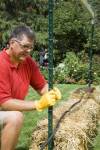
Karsten recommends erecting seven-foot-tall posts at the end of each row
of bales, and running wire between them at intervals of 10 inches from
the tops of the bales. As your seeds sprout, you can use the bottom wire
to drape a plastic tarp to create an instant greenhouse for those
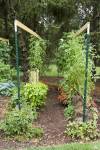
chilly early-season nights. And as the plants begin to grow, the wire
works like a vertical trellis, supporting your cucumbers, squash and
assorted viney vegetables.5. Time to plant
If you’re planting seedlings, use your trowel to separate the straw
in the shape of a hole and add some sterile planting mix to help cover
the exposed roots. If you’re planting seeds, then cover the bales with a
one to two-inch layer of planting mix and sew into this seedbed. As the
seeds germinate, they’ll grow roots down into the bale itself. While
you’re at it, plant some annual flowers into the sides of the bales, or
some herbs — it’s otherwise underutilized growing space, and will make
the garden a whole lot lovelier.6. Look, ma — no weeding
If you lay a soaker hose over your bales, you’ve pretty much
eliminated all your work until harvest. That’s because your “soil”
doesn’t contain weed seeds. There’s one caveat, though — if you didn’t
get your straw from a farmer (guilty as charged), there’s a chance your
straw (or, worse, hay that was sold as straw) contains its own seed. If
your bales start to sprout what looks like grass, you can beat back the
Chia pet effect by washing the sprouts with diluted vinegar. If you
don’t mind the look though, the grass shouldn’t harm your plants, and
will likely die off from the heat produced by the bale’s decomposition.7. The harvest after the harvest
When the harvest season ends, the bales will be soft, saggy and gray —
but that’s exactly what you want. Because when you pile the straw
together and leave it to compost over winter, you’ll have a mound of
beautiful compost to fill all your pots and planters in the spring.Have never done this, but I am super interested! Pretty amazing.
I’ve done this in my class because our ‘garden area’ was all gravel. Works pretty well!

 The Carving Witch